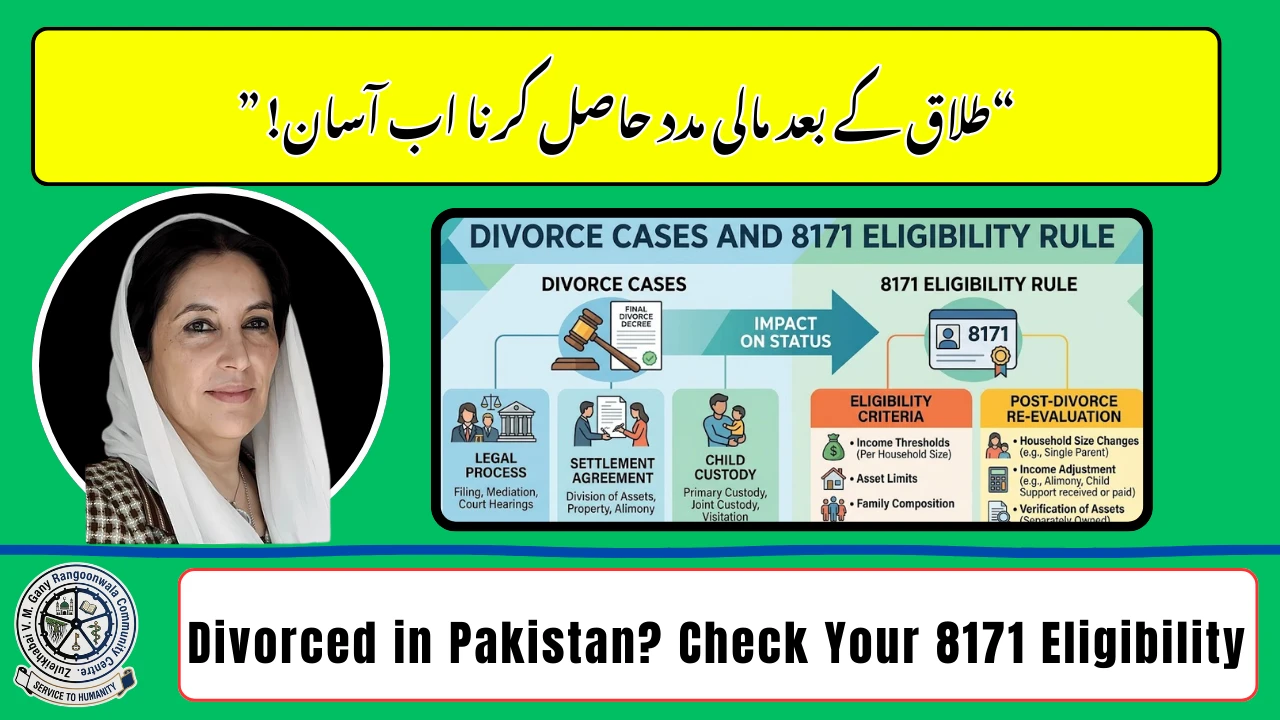
f you are divorced in Pakistan and want to check your eligibility for the 8171 financial aid program, this guide provides the most practical and up-to-date information. Divorce can affect your application, but knowing the exact rules, required documents, and the step-by-step process ensures you don’t miss out. This article covers everything from eligibility criteria and document requirements to how to apply and track your application status, helping you secure your rightful benefits efficiently and safely.
What Is the 8171 Program?
The 8171 program is a government-backed social welfare initiative under BISP/Ehsaas, designed to support financially vulnerable families in Pakistan. It primarily targets widows, divorced women, and low-income households. The program provides cash assistance to cover essential expenses and improve family well-being.
Benefits include:
- Monthly cash transfers
- Support for household expenses
- Priority for women as heads of households
This program ensures that divorce or widowhood does not leave individuals without financial support.

How Divorce Cases Affect 8171 Eligibility
Divorce is a key factor for eligibility under 8171. Understanding this is critical:
- Primary Beneficiaries: Divorced women are prioritized, as they often become heads of households after separation.
- Legal Proof Required: A valid divorce certificate or family court decree must be submitted.
- Financial Criteria: Household income must fall below the government-defined poverty threshold.
- Other Conditions: Applicants must have a CNIC and proof of residence.
Divorced men can apply in some situations, such as when the woman is unable to register herself. However, women remain the primary focus.
Step-by-Step Guide to Check 8171 Eligibility
| Step | Action | Notes |
|---|---|---|
| 1 | Gather required documents | Divorce certificate, CNIC, income proof |
| 2 | Visit the official portal | Ehsaas/BISP 8171 online registration |
| 3 | Fill out the form | Provide personal and family details accurately |
| 4 | Upload supporting documents | PDF/JPEG copies of divorce certificate, CNIC, and proof of residence |
| 5 | Submit the application | Double-check all entries before submission |
| 6 | Track application status | Via SMS or online portal |
| 7 | Receive assistance | If eligible, cash is transferred to your bank account |
This process ensures that applicants do not face delays due to missing documents or errors in submission.

Required Documents
For divorce-related 8171 applications, you need:
- CNIC of the applicant
- Divorce certificate or family court decree
- Proof of residence (utility bill, ration card, or lease)
- Bank account for cash transfer
- Family income proof (if requested)
Having these documents ready speeds up the verification process and reduces rejection chances.

Important Dates and Cycles
- Applications can be submitted year-round.
- Cash disbursement occurs in scheduled cycles—usually every 2–3 months.
- Keep checking the official Ehsaas/BISP portal to ensure your application aligns with the current cycle.
Conclusion
Divorce should not block your access to essential financial support. Gather your documents, check your eligibility, and apply through the 8171 portal today. Stay updated on cycles and ensure you submit accurate information to receive timely assistance. Don’t delay—secure your benefits now.
FAQs
Who qualifies for 8171 if divorced?
Divorced women with valid CNICs and below-threshold family income are eligible for assistance.
Can divorced men apply for 8171?
Yes, in cases where the woman cannot apply herself, men may apply if they meet income and household criteria.
How long does it take to process an application?
Processing typically takes 4–6 weeks after document submission.
Can I update my divorce status after applying?
Yes. Update your profile with new documents on the portal to maintain eligibility.
Where can I check 8171 application status?
Status can be tracked online via the official Ehsaas/BISP portal or by sending an SMS to the registered number.
What if my application is rejected?
If rejected, review the reason given, correct any missing documents or errors, and reapply during the next cycle.
Can divorced women with remarriage apply?
Yes, but the eligibility may change if family income or household status has significantly changed.